You’ve Been Following the Money. That’s Why You’re Losing the Spec.
Most HVAC companies think they understand the buyer journey because they know who writes the check.
That is where the mistake starts.
I have spent years working inside technical industries, decoding how organizations actually make decisions versus how they think they make decisions. And in HVAC, there is a gap between those two things that costs manufacturers and rep firms millions of dollars in lost business every year. Not because they lack product quality. Not because they lack relationships. Because they are targeting the wrong person, at the wrong moment, through the wrong channel.
Here’s what I’m seeing.
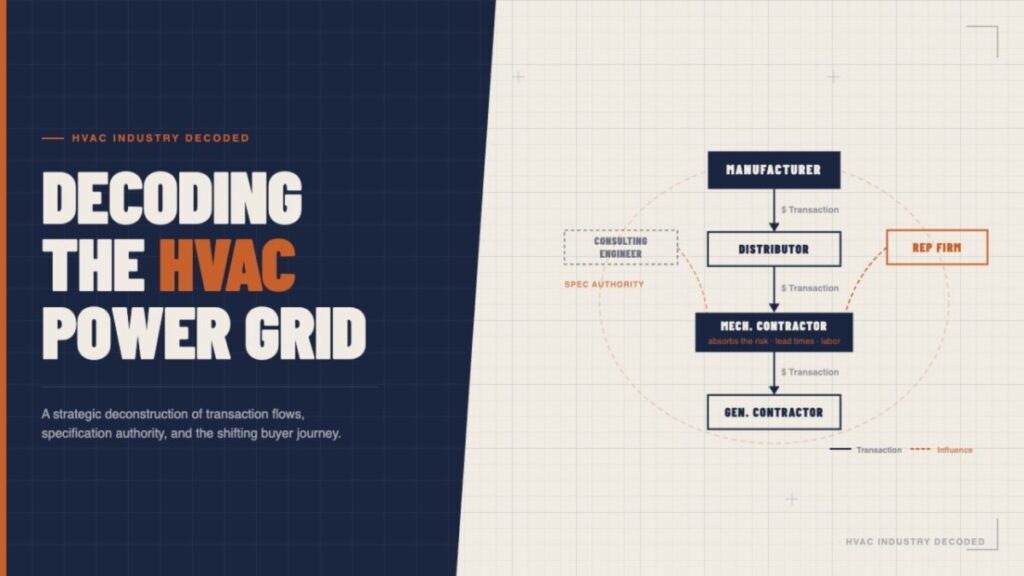
The transaction flow and the influence flow are not the same map. And most sales strategies, marketing programs, and onboarding systems are built on the transaction flow while the competition is quietly winning on the influence flow.
Let me show you what that actually means.
Follow the Pen, Not Just the Money
In commercial Design-Bid-Build, the MEP consulting engineer of record is the power node. They are hired by the architect or owner. They write the equipment spec. A “no substitution” spec from that engineer holds over 80% of the time. The money moves through the mechanical contractor, then the GC, then the building owner. But the decision was made before a single dollar moved.
Rep firms understand this. Their power is spec position, not transaction ownership. They never take title. They never touch the purchase. They earn a manufacturer commission on distributor sales in their territory, typically between 5 and 12 percent. And they shape the market entirely through their relationship with consulting engineers and their ability to get a product specified.
If your go-to-market strategy is built around the money flow, you are showing up after the game is already over.
Channel Compression Changes Everything
Here is what most people explain on whiteboards but rarely build strategy around: every channel compresses authority differently.
In Commercial Design-Bid-Build, specification authority sits with the MEP consulting engineer. The rep firm’s job is to win that relationship before the spec is written. A no-substitution spec essentially closes the door for competitors at bid time.
In Design-Build, the rules shift entirely. The owner pays one entity for design and construction. The DB contractor subcontracts the MEP engineer. Cost pressure flows upward through that relationship, which means the DB contractor, not the engineer, effectively dictates equipment selection. Rep firm strategy in that channel has to pivot. The relationship with the consulting engineer matters less than the relationship with the DB contractor’s preferred mechanical sub.
In Retrofit and Owner-Direct, the channel compresses further. No architects. No GCs. No commissioning agents. The mechanical service contractor holding the preventive maintenance contract becomes the de facto specifying authority. They recommend the unit. The asset manager or procurement team controls budget approval. The person influencing and the person approving are two completely different people with two completely different priorities.
And in residential? Total compression. The HVAC contractor holds all roles simultaneously. Specifier, buyer, installer, service provider. Manufacturer loyalty programs and tiering structures drive the entire relationship at that level.
Four channels. Four completely different authority structures. One sales motion does not serve all four.
ESCOs Create a Bypass Circuit
Energy Service Companies are a category that manufacturers and rep firms often underestimate until they encounter them on a major account.
ESCOs like Trane, JCI, Honeywell, and Ameresco operate through Energy Savings Performance Contracts. They guarantee energy savings and use those savings to finance the equipment. Zero upfront capital required for the owner. This is why ESCOs dominate in K-12 education, government, and higher education settings where deferred maintenance backlogs and constrained capital budgets would otherwise prevent any purchasing activity.
The strategic implication is this: once an ESCO is engaged on an account, you are no longer in a direct sales relationship. You are a subcontractor. Every major ESCO maintains strict internal Approved Equipment Lists. If your manufacturer is not on that list, you are excluded before scoping begins. The sales conversation does not start at the project level. It starts at the corporate relationship level, years before the project exists.
Most companies find out they are off an approved list when they lose a job. The ones who win in that space figured out the access point long before the project scope was written.
The Aftermarket Is Where the Multiplier Lives
The equipment sale is not the business. The equipment sale is the door.
The initial capital sale happens once every 15 to 20 years. It involves engineers, GCs, and reps. It gets the visibility. But the aftermarket, which includes preventive maintenance contracts, T&M repair, parts margins, controls upgrades, and building automation system integration, generates 3 to 5 times the value of the original equipment sale over the asset’s lifecycle.
The facility manager’s operational triggers are what fuel this. ASHRAE Standard 55 for thermal comfort and ASHRAE 62.1 for ventilation. Occupant complaints drive the service calls. Uptime requirements drive the PM contracts. And the maintenance manager, not the facility director, is the person who recommends the vendor and pulls the relationship upward to budget authority.
Win the maintenance manager’s trust and you get the recommendation. Win the recommendation and you get the recurring revenue. Teams that treat aftermarket as a service afterthought are leaving the most predictable revenue in the industry on the table.
Regulatory Disruption Is a Training Problem
The AIM Act is phasing down high-GWP HFC refrigerants across the industry. R-410A, the dominant commercial refrigerant, faces strict manufacturing limits on new equipment starting January 1, 2025. The replacements, R-454B and R-32, are A2L classified. Mildly flammable. Not backward compatible.
This creates a contractor shockwave. New recovery equipment. New manifold gauges. Updated EPA Section 608 certifications. Updated ASHRAE Standard 15 compliance affecting mechanical code changes at the local level.
But here is what most manufacturers are missing: this is not primarily a product problem. It is a training and readiness problem. The OEMs and contractors that complete A2L readiness earliest will capture market share aggressively. Because readiness is now a competitive differentiator. And that readiness requires your people, your distribution partners, and your customers to have a shared understanding of what changed, why it changed, and what to do about it.
If your organization is still explaining A2L through product sheets and data tables, you are behind the companies turning that knowledge into structured training assets their entire channel can use.
The Knowledge Is Already There. The System Is Not.
Here is what I observe consistently when I work with technical organizations in this industry.
The expertise exists. CEOs and founders who have been in HVAC for 20 years understand the spec game in DBB better than most strategy consultants ever will. Senior rep firm principals know exactly which consulting engineers to build relationships with and why. Experienced service managers can tell you with precision which facility management contacts control budget authority in healthcare versus K-12.
That knowledge lives in ride-alongs. In sales meetings. In whiteboard sessions. In the way a 20-year veteran explains the ESCO dynamic to a new hire over lunch.
And when that person leaves, retires, or simply gets too busy to explain it again, the organization loses.
The scaling problem is not a talent problem. It is a knowledge transfer problem. Sales teams interpret the market differently because no one built the shared framework. Marketing oversimplifies the buyer journey because no one gave them the authority map. New hires take 12 to 18 months to develop channel instincts that could be accelerated with structured assets built from the expertise that already exists in the building.
This is what the deck we created at Nerd Herd is built around. A strategic deconstruction of HVAC transaction flows, specification authority, and the shifting buyer journey, designed to make this tribal knowledge teachable, repeatable, and scalable.
The Deck Is a Starting Point. The Full Document Goes Deeper.
Before distilling this into the current slide deck, I built a more comprehensive technical HTML document that maps every layer of this in detail. Channel by channel. Vertical by vertical. Authority role by authority role.
If you want either version, email me at ashleir@nerdherdpro.com with the subject line “HVAC Industry Decoded” and I will forward it directly.
We are also opening the waitlist for our first bootcamp cohort starting in July 2026. It is a 10-week program for people inside HVAC organizations who are ready to become AI champions and build strategic assets like this for their teams. People who are tired of watching institutional knowledge walk out the door and want a system to capture it.
The expertise in your organization is worth more than your current systems allow it to be. That is worth addressing.
Originally published in Ashlei Rolloff’s HVAC Leaders newsletter on LinkedIn.
Quick answers
Who influences the spec on an HVAC project?
The engineer of record and the design team often decide which products get specified, long before a contractor or owner writes the check. Manufacturers who target only the buyer on the purchase order reach the decision too late.
What is influence flow in HVAC sales?
Influence flow tracks who shapes the decision at each stage of a project. Transaction flow tracks who pays whom. Competitors who reach the influencers earlier win the spec.
How should HVAC manufacturers adjust their marketing?
Map who influences each stage of the project, then build content, rep training, and outreach for those people at the moment they decide. Start with the engineers and designers who write the spec.
Work with Nerd Herd
Win more bids with marketers who speak spec sheet
Book a 30-minute strategy call and we will show you where your marketing is losing bids and what to fix first.