• Skip to primary navigation
  • Skip to main content
  • Skip to footer
Nerd Herd logo

Nerd Herd

  • About
  • AI Education
  • Proven Process
  • Work With Us
  • Our Work
  • Insights
  • Podcast
  • Book a Strategy Call

Ashlei Rolloff

Your spec sheet is losing deals you never hear about

October 13, 2026 by Ashlei Rolloff

Your spec sheet is losing deals you never hear about

Earlier this year I interviewed a veteran rep about a job he should have won.

His lines were basis of design on the chillers, the pumps, and the cooling towers. Top to bottom, the system was his. Then a competitor quoted a lighter-built air handler packaged with their chiller, value engineered the scope down, and offered a faster lead time. When the dust settled, he got an order for towers and pumps. The competitor got the air handlers and the chillers.

“When you’re basis of design top to bottom,” he told me, “you don’t lose.” Except he did. And then he said the line I haven’t been able to shake: in a fair fight, the smaller manufacturer never wins. His job is to make the fight not fair.

If you lead sales or marketing at a $30 million to $300 million manufacturer, you know that feeling. And here’s the hard part. That loss will never show up in your CRM with a useful reason next to it.

The loss reason you can’t see

This year I also helped a manufacturer client dig through their closed-lost data. The top loss reason was value engineering or a design change. Some projects were redesigned until their scope disappeared entirely. The third most common reason was “lost,” with nothing else written down.

That pattern isn’t unusual. A lost spec doesn’t come with an exit interview. The engineer stays with the brand they already know, the contractor swaps you out at VE, and the job shows up on someone else’s books. Your team logs “VE” and moves on to the next bid.

But VE is rarely the real reason. It’s the moment the real reason caught up with you. Somewhere earlier, the contractor didn’t know your install story, the owner never asked for you by name, or the engineer couldn’t defend you when the swap came up.

Over the last year I listened back through dozens of conversations with manufacturers, reps, and engineers. The same gap kept showing up. The product was good. The spec sheet was accurate. The people deciding whether to buy it each needed a different reason, and that reason lived in someone’s head instead of on the page.

If you want to see where your own spec sheet stands before reading further, run one product through our free tool at specsheet.nerdherdpro.com. It takes a couple of minutes.

You know your buyers. Your materials don’t show it.

You don’t need me to explain who’s in the buying chain. You’ve lived it. But look at your spec sheet and ask who it was written for. Usually the answer is everyone, which means no one.

The consulting engineer is protecting their stamp. They need certified ratings at stated test conditions, sound power by octave band, and a submittal they can defend.

The contractor is protecting their margin and schedule. Shipping splits, rigging weights, whether it fits through the existing opening. This is the person deciding your fate at VE.

The owner with a design standard, the school district, health system, or university, can write you in or out of every future project. Most manufacturers never give them a reason.

And your rep carries fifteen or twenty lines. They’ll lead with whichever manufacturer made the story easiest to tell that day. That’s competition most leadership teams underestimate. It isn’t only the brand on the basis of design. It’s every other line in your rep’s bag.

What your reps are actually asking for

When I asked that same rep what would help him win more often, he didn’t ask for a better brochure. He asked for documentation.

He wanted the cooling coil, the fan, and the electrical detail, MCA and all, in one clean package an engineer could approve without chasing anyone. He wanted a Revit model early in the job, because almost every engineer he works with designs in it now. And he wanted selections fast. His current selection took 18 minutes. His expectation was about five, with reasonable accuracy on the first pass.

None of that is marketing in the traditional sense. All of it is translation. It’s the factory taking what engineering knows and packaging it the way the people downstream need to use it.

That’s the part I think most leadership teams miss. Your rep firm isn’t only comparing you to the brand on the basis of design. They’re comparing how much work it takes to sell you against how much work it takes to sell the other fifteen lines in their bag. Every missing number, slow selection, or vague claim is friction. Friction decides where a good rep spends their Tuesday afternoon.

The manufacturers who win more than their size suggests have usually figured this out. They make it easy for the engineer to defend them, easy for the contractor to install them, and easy for the rep to tell the story. That’s how you make the fight not fair.

What translation actually looks like

Here’s a line that could come from almost any catalog in our industry:

“High-efficiency variable speed compressor delivers quiet, reliable operation.”

It’s accurate. It’s also useless to every person in the buying chain, because none of them can do anything with it.

Here’s the same product, translated:

For the engineer: “IEER of [insert AHRI-certified value] at AHRI 340/360 conditions. Sound power by octave band available per [insert test standard].” Now they have something they can put in a spec section, and the brackets tell your team exactly what data to pull.

For the contractor: “Variable speed compressor ships factory-wired and tested. [Insert rigging weight] and [insert curb dimensions] for retrofit fit-up.” Now they know what it means for their crew on install day, which is the conversation that decides VE.

For the owner: “Variable speed operation reduces compressor cycling, with [insert warranty term] on the compressor.” Now the facility director has a reason to tell their engineer what they want on the next job.

Same product. Same specs. Three reasons to buy, each one built only from data you already have or can get.

That’s the whole idea. The fix is almost never more content. It’s translating the content you have into the sentence each decision-maker needs to hear, with the proof they’ll actually check. And every claim has to trace back to the spec sheet. If the data isn’t there, you don’t stretch it. You flag it and go get it.

Want to see your own product translated this way? Paste in a spec sheet at specsheet.nerdherdpro.com and you’ll get a free preview in a couple of minutes.

The refrigerant transition just raised the stakes

If you make anything with a compressor, you’re living through this right now. The move to A2L refrigerants like R-454B and R-32 has every manufacturer rewriting spec sheets, retraining reps, and fielding new questions from engineers.

Those questions are specific. Which edition of UL 60335-2-40 is the unit listed to? What’s the refrigerant charge? Does the application need leak detection and mitigation, and is it factory-installed? Who’s responsible for it in the field?

Engineers are cautious with anything new, and A2L is new to a lot of them. The manufacturer whose spec sheet answers those questions plainly makes the engineer’s job easier. The one that buries them in a footnote makes the engineer call someone, and the engineer doesn’t always call.

This is the moment where a clear, translated spec sheet is worth the most. Your competitors are rewriting theirs too. The ones who get it right first will win specs that don’t come back for years.

We built a tool to do the first pass

Doing this translation by hand takes time, and most teams only get to it for one or two hero products. So we built a free tool for VPs of sales and marketing at commercial and industrial manufacturers. It’s called the Spec Sheet to Sales Kit.

You paste in your spec sheet or upload the PDF, and pick up to four people who influence the purchase. You’ll see a free preview right away, including the message for your primary decision-maker and your readiness score. Enter your name and work email, and you get the full kit on screen plus a PDF in your inbox.

[Image: the spec readiness score card]

The full kit includes:

  • A VP brief with where this product wins, where it stalls, the revenue at risk, and a 30-day plan for reps, marketing, and product.
  • The message for each decision-maker, with a headline, the proof they’ll check, what to avoid saying, and what to ask for.
  • A spec readiness score against 12 checks engineers run before they list a product, including refrigerant and low-GWP status.
  • Spec-stage objections with answers built from your own data, a 60-second rep briefing, and a spec-in email to an engineer.
  • A PDF you can bring to your next sales meeting or send to your rep firms.

[Image: page 1 of a sample kit PDF, showing the VP brief]

Every claim is checked against your spec, with the source line quoted so you can verify it. Missing data shows up in brackets. It won’t invent a feature or round up a number. And we don’t store your spec sheet. We save the kit it produces so your PDF link keeps working.

What to do with your kit this week

Start with the product that should be winning and isn’t. The one with strong performance that keeps losing at VE or to the basis of design. If you have an A2L product launching, start there.

Read the VP brief first. It will tell you whether you’re looking at a messaging problem, a data problem, or both.

Put the 30-day plan on the agenda for your next sales meeting. Send the 60-second briefing to your top rep firms and ask them to use it on their next three engineer calls.

Then ask those reps one question when they report back: which line did the engineer react to? Their answer is better market research than most surveys you could buy. It tells you which proof points carry weight in your territory, and which ones your reps quietly stopped using. Feed that back into the next version of your spec sheet.

Send the spec gaps to product. The gaps are usually data you already have somewhere, like sound power, a points list, or warranty terms. It just isn’t where the engineer is looking.

Then publish what you fix everywhere it matters: the spec sheet, the submittal package, and the product page. That’s what makes you findable by engineers, and by the AI search tools more of them are starting to use.

Make the fight not fair

That rep was right. A mid-size manufacturer rarely wins on brand or scale. You win by being the easiest choice for every person in the chain, before anyone ever gets to VE.

Your engineering team already did the hard part. The gap between your spec sheet and a signed purchase order is translation, and it’s one of the most fixable revenue problems I see.

Run your first kit free at specsheet.nerdherdpro.com.

And tell me something in the comments. What’s the one piece of data engineers ask your reps for that isn’t in your submittal today?

Ashlei Rolloff Founder/CEO, Nerd Herd

Originally published in Ashlei Rolloff’s HVAC Leaders newsletter on LinkedIn.

Quick answers

Why do HVAC manufacturers lose jobs they were basis of design on?

Competitors package equipment, value engineer the scope, and offer faster lead times. When your materials only list specs, reps and contractors have nothing to counter with. Those losses rarely show up in the CRM with a useful reason, so the pattern repeats.

What is a sales kit for an HVAC product?

A sales kit translates your spec sheet into messaging for each buyer who decides on the product, such as the engineer, contractor, owner, and rep. Every conversation then answers what that person cares about.

How can a manufacturer build a sales kit fast?

Paste your spec sheet into the free Nerd Herd sales kit tool at specsheet.nerdherdpro.com. It drafts messaging for each buyer plus a 30-day plan for your team, which gives you a first pass to refine with your reps.

Keep reading: HVAC marketing strategy consulting and content marketing for HVAC manufacturers.

Work with Nerd Herd

Turn your spec sheet into a sales kit

Paste a spec sheet and get messaging for each buyer who decides on your product, plus a 30-day plan for your team.
Build my sales kit

Filed Under: Insights

Why following the money in HVAC is the most expensive strategy in the room

April 28, 2026 by Ashlei Rolloff

Why following the money in HVAC is the most expensive strategy in the room

You’ve Been Following the Money. That’s Why You’re Losing the Spec.

Most HVAC companies think they understand the buyer journey because they know who writes the check.

That is where the mistake starts.

I have spent years working inside technical industries, decoding how organizations actually make decisions versus how they think they make decisions. And in HVAC, there is a gap between those two things that costs manufacturers and rep firms millions of dollars in lost business every year. Not because they lack product quality. Not because they lack relationships. Because they are targeting the wrong person, at the wrong moment, through the wrong channel.

Here’s what I’m seeing.

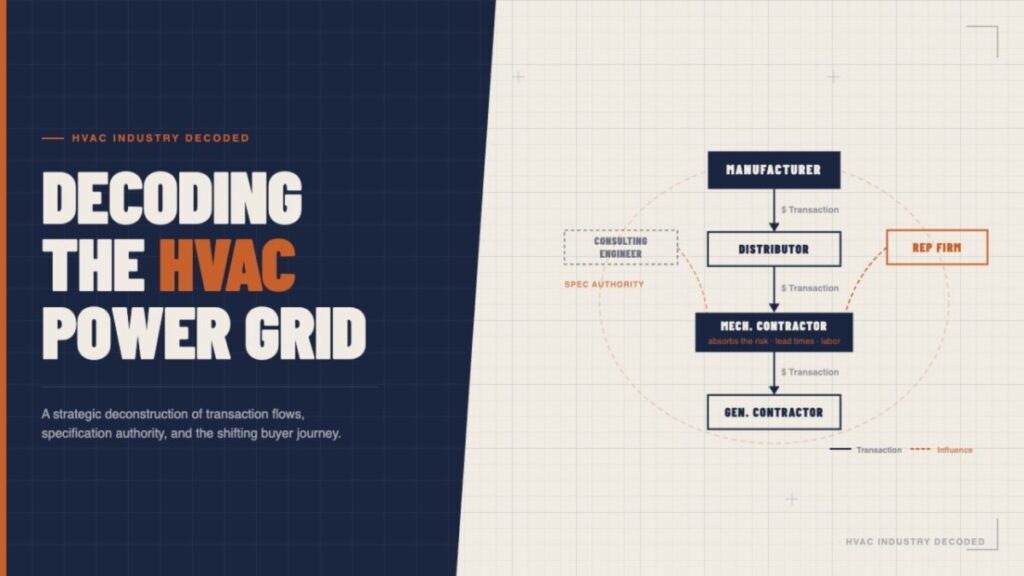
The transaction flow and the influence flow are not the same map. And most sales strategies, marketing programs, and onboarding systems are built on the transaction flow while the competition is quietly winning on the influence flow.

Let me show you what that actually means.

Follow the Pen, Not Just the Money

In commercial Design-Bid-Build, the MEP consulting engineer of record is the power node. They are hired by the architect or owner. They write the equipment spec. A “no substitution” spec from that engineer holds over 80% of the time. The money moves through the mechanical contractor, then the GC, then the building owner. But the decision was made before a single dollar moved.

Rep firms understand this. Their power is spec position, not transaction ownership. They never take title. They never touch the purchase. They earn a manufacturer commission on distributor sales in their territory, typically between 5 and 12 percent. And they shape the market entirely through their relationship with consulting engineers and their ability to get a product specified.

If your go-to-market strategy is built around the money flow, you are showing up after the game is already over.

Channel Compression Changes Everything

Here is what most people explain on whiteboards but rarely build strategy around: every channel compresses authority differently.

In Commercial Design-Bid-Build, specification authority sits with the MEP consulting engineer. The rep firm’s job is to win that relationship before the spec is written. A no-substitution spec essentially closes the door for competitors at bid time.

In Design-Build, the rules shift entirely. The owner pays one entity for design and construction. The DB contractor subcontracts the MEP engineer. Cost pressure flows upward through that relationship, which means the DB contractor, not the engineer, effectively dictates equipment selection. Rep firm strategy in that channel has to pivot. The relationship with the consulting engineer matters less than the relationship with the DB contractor’s preferred mechanical sub.

In Retrofit and Owner-Direct, the channel compresses further. No architects. No GCs. No commissioning agents. The mechanical service contractor holding the preventive maintenance contract becomes the de facto specifying authority. They recommend the unit. The asset manager or procurement team controls budget approval. The person influencing and the person approving are two completely different people with two completely different priorities.

And in residential? Total compression. The HVAC contractor holds all roles simultaneously. Specifier, buyer, installer, service provider. Manufacturer loyalty programs and tiering structures drive the entire relationship at that level.

Four channels. Four completely different authority structures. One sales motion does not serve all four.

ESCOs Create a Bypass Circuit

Energy Service Companies are a category that manufacturers and rep firms often underestimate until they encounter them on a major account.

ESCOs like Trane, JCI, Honeywell, and Ameresco operate through Energy Savings Performance Contracts. They guarantee energy savings and use those savings to finance the equipment. Zero upfront capital required for the owner. This is why ESCOs dominate in K-12 education, government, and higher education settings where deferred maintenance backlogs and constrained capital budgets would otherwise prevent any purchasing activity.

The strategic implication is this: once an ESCO is engaged on an account, you are no longer in a direct sales relationship. You are a subcontractor. Every major ESCO maintains strict internal Approved Equipment Lists. If your manufacturer is not on that list, you are excluded before scoping begins. The sales conversation does not start at the project level. It starts at the corporate relationship level, years before the project exists.

Most companies find out they are off an approved list when they lose a job. The ones who win in that space figured out the access point long before the project scope was written.

The Aftermarket Is Where the Multiplier Lives

The equipment sale is not the business. The equipment sale is the door.

The initial capital sale happens once every 15 to 20 years. It involves engineers, GCs, and reps. It gets the visibility. But the aftermarket, which includes preventive maintenance contracts, T&M repair, parts margins, controls upgrades, and building automation system integration, generates 3 to 5 times the value of the original equipment sale over the asset’s lifecycle.

The facility manager’s operational triggers are what fuel this. ASHRAE Standard 55 for thermal comfort and ASHRAE 62.1 for ventilation. Occupant complaints drive the service calls. Uptime requirements drive the PM contracts. And the maintenance manager, not the facility director, is the person who recommends the vendor and pulls the relationship upward to budget authority.

Win the maintenance manager’s trust and you get the recommendation. Win the recommendation and you get the recurring revenue. Teams that treat aftermarket as a service afterthought are leaving the most predictable revenue in the industry on the table.

Regulatory Disruption Is a Training Problem

The AIM Act is phasing down high-GWP HFC refrigerants across the industry. R-410A, the dominant commercial refrigerant, faces strict manufacturing limits on new equipment starting January 1, 2025. The replacements, R-454B and R-32, are A2L classified. Mildly flammable. Not backward compatible.

This creates a contractor shockwave. New recovery equipment. New manifold gauges. Updated EPA Section 608 certifications. Updated ASHRAE Standard 15 compliance affecting mechanical code changes at the local level.

But here is what most manufacturers are missing: this is not primarily a product problem. It is a training and readiness problem. The OEMs and contractors that complete A2L readiness earliest will capture market share aggressively. Because readiness is now a competitive differentiator. And that readiness requires your people, your distribution partners, and your customers to have a shared understanding of what changed, why it changed, and what to do about it.

If your organization is still explaining A2L through product sheets and data tables, you are behind the companies turning that knowledge into structured training assets their entire channel can use.

The Knowledge Is Already There. The System Is Not.

Here is what I observe consistently when I work with technical organizations in this industry.

The expertise exists. CEOs and founders who have been in HVAC for 20 years understand the spec game in DBB better than most strategy consultants ever will. Senior rep firm principals know exactly which consulting engineers to build relationships with and why. Experienced service managers can tell you with precision which facility management contacts control budget authority in healthcare versus K-12.

That knowledge lives in ride-alongs. In sales meetings. In whiteboard sessions. In the way a 20-year veteran explains the ESCO dynamic to a new hire over lunch.

And when that person leaves, retires, or simply gets too busy to explain it again, the organization loses.

The scaling problem is not a talent problem. It is a knowledge transfer problem. Sales teams interpret the market differently because no one built the shared framework. Marketing oversimplifies the buyer journey because no one gave them the authority map. New hires take 12 to 18 months to develop channel instincts that could be accelerated with structured assets built from the expertise that already exists in the building.

This is what the deck we created at Nerd Herd is built around. A strategic deconstruction of HVAC transaction flows, specification authority, and the shifting buyer journey, designed to make this tribal knowledge teachable, repeatable, and scalable.

The Deck Is a Starting Point. The Full Document Goes Deeper.

Before distilling this into the current slide deck, I built a more comprehensive technical HTML document that maps every layer of this in detail. Channel by channel. Vertical by vertical. Authority role by authority role.

If you want either version, email me at ashleir@nerdherdpro.com with the subject line “HVAC Industry Decoded” and I will forward it directly.

We are also opening the waitlist for our first bootcamp cohort starting in July 2026. It is a 10-week program for people inside HVAC organizations who are ready to become AI champions and build strategic assets like this for their teams. People who are tired of watching institutional knowledge walk out the door and want a system to capture it.

The expertise in your organization is worth more than your current systems allow it to be. That is worth addressing.

Originally published in Ashlei Rolloff’s HVAC Leaders newsletter on LinkedIn.

Quick answers

Who influences the spec on an HVAC project?

The engineer of record and the design team often decide which products get specified, long before a contractor or owner writes the check. Manufacturers who target only the buyer on the purchase order reach the decision too late.

What is influence flow in HVAC sales?

Influence flow tracks who shapes the decision at each stage of a project. Transaction flow tracks who pays whom. Competitors who reach the influencers earlier win the spec.

How should HVAC manufacturers adjust their marketing?

Map who influences each stage of the project, then build content, rep training, and outreach for those people at the moment they decide. Start with the engineers and designers who write the spec.

Keep reading: HVAC marketing strategy consulting and demand generation and SEO.

Work with Nerd Herd

Win more bids with marketers who speak spec sheet

Book a 30-minute strategy call and we will show you where your marketing is losing bids and what to fix first.

Book a strategy call

Filed Under: Insights

Your essential guide to AHR Expo 2026 in Las Vegas

January 31, 2026 by Ashlei Rolloff

Your essential guide to AHR Expo 2026 in Las Vegas

After attending dozens of AHR Expos and helping hundreds of HVAC professionals navigate the show floor, I’ve refined the formula for maximizing your time at the largest HVACR marketplace in the world. AHR Expo 2026 hits Las Vegas February 2-4, and whether this is your first show or your fifteenth, these field-tested strategies will transform how you experience the event.

Before You Arrive: The Planning That Pays Off

Build Your Strategic Hit List

Create a prioritized list in your phone organized by hall and booth number. Include the booth name, specific contact person, and booth number. As you complete each meeting, check it off, this becomes your post-show follow-up roadmap and prevents that sinking feeling of “Wait, who was that person I met at booth 4523?”

Pro tip: Schedule 15-30 minutes between appointments. You will run into colleagues, former classmates, and industry connections. That buffer time transforms chance encounters into valuable networking moments instead of stressful delays.

Download the AHR App Early

Familiarize yourself with the layout, educational session schedule, and navigation features before you land. Knowing how to quickly locate booth numbers when someone says “Meet me at booth 2847” saves precious time on the show floor.

Pre-Show Networking Starts Now

Connect with manufacturers, line card partners, and industry peers on LinkedIn before the show. Schedule coffee meetings or booth visits in advance. When you arrive with a calendar full of confirmed appointments rather than hoping to “catch people when you see them,” your show becomes exponentially more productive.

Getting There: Vegas-Specific Logistics

Airport Pickup Strategy

After baggage claim, head to Level 2 of the parking garage via escalator or elevator for rideshare pickup. Select “Garage Level 2” in your app. If you’re flying Delta (always Gate D), remember you’ll need the tram, add 10-15 minutes to your arrival plans.

Smart Rideshare Timing

Call your ride as you deplane and select “Wait & Save”, by the time you reach the pickup area, your driver will be there, and you’ll save approximately $10. Hotels like the Encore, Wynn, and Resorts World are typically 15-20 minutes from the airport.

Don’t Skip TSA Time on Departure

Security lines can stretch 30-60 minutes during the show. Plan accordingly or risk missing your flight while still buzzing from the energy of the expo floor.

Show Floor Essentials: What to Pack and Wear

The Golden Rule: Tennis Shoes and a Backpack

This is non-negotiable. You’ll walk miles over three days. Cute flats work if you must, but heels? That’s a rookie move everyone regrets by noon on Day One. The industry gives everyone a pass on tennis shoes with dress pants, take advantage.

Pack a backpack, not a shoulder bag or purse. Your shoulders will thank you after collecting materials, samples, and those unexpectedly heavy product catalogs. Small crossbodies are acceptable if you’re truly traveling light.

The Survival Kit

  • Water bottle + Liquid IV packets (Vegas is dry; conference floors are crowded)
  • Snacks, mints, gum (expo food is underwhelming)
  • Business cards (bring more than you think you need and know how to scan the LinkedIn QR code on your phone)
  • Hand sanitizer & wipes (pre-wipe your plane seat; don’t start the show sick. Hand sanitizer between meetings)
  • Advil, Tums, Vitamin C (travel does weird things to bodies, plus let’s be real, most of us are not in our twenties anymore)
  • Travel-size everything to maximize luggage space
  • Layers (Vegas fluctuates from 70°F days to 40-50°F nights)

Footwear Arsenal

  • Tennis shoes (show floor)
  • Flats or comfortable sandals (meetings)
  • Thick heels or wedges (evening events, comfort still matters)
  • Tennis shoes (show floor)
  • Flats or comfortable sandals (meetings)
  • Thick heels or wedges (evening events, comfort still matters)

Maximizing Your Show Experience

Strategic Walking

Don’t just hit your list. Walk the show with an eye for inspiration. Which booths have the best giveaways? Creative displays? Engaging experiences? Grab flyers from standout exhibits, they’re goldmines for your own booth planning next year.

The Monday Evening Booth Happy Hour

Schedule at least one booth happy hour as your final Monday event before dinner plans begin. It’s where the real relationship-building happens in a more relaxed environment.

Beyond the Expo Floor

  • Check out the ASHRAE Winter Conference running concurrently
  • Attend the HVAC Tactical Awards
  • Book educational sessions in advance (they’re located past the expo halls)
  • Check out the ASHRAE Winter Conference running concurrently
  • Attend the HVAC Tactical Awards
  • Book educational sessions in advance (they’re located past the expo halls)

Stay Connected

After every meaningful conversation, follow up via email or LinkedIn within 48 hours. For strong connections, suggest a 15-minute monthly check-in to maintain momentum. Document these relationships in an Excel tracker with personal notes, what you discussed, their current challenges, potential collaboration opportunities.

Vegas-Specific Perks and Planning

Pre-Book the Spa

If relaxation is on your agenda, book before you arrive. Appointments during conference weeks fill quickly. Check if your hotel pool/hot tub will be operational, some properties schedule maintenance during low seasons, even when conferences are in town.

Take a Robotaxi Ride

Download the Zoox app to experience fully autonomous, driverless rides between Strip locations. The service is currently free and covers key points including Resorts World, Luxor, and New York-New York. It’s part innovation showcase, part convenient transportation, and entirely on-brand for Vegas.

Build Your Personal Show Guide

Start an Excel document to track year-over-year insights: restaurants you loved, transportation hacks, hotels to avoid, booths that impressed you, networking wins. This becomes your personalized playbook that improves with every show.

The Post-Show Follow-Through

The expo doesn’t end when you leave the floor. Your checked-off list becomes your follow-up roadmap. Send personalized connection requests on LinkedIn referencing your specific conversation. These relationships, not the swag bags, are the true ROI of attending AHR.

AHR Expo 2026 is where deals are made, partnerships are formed, and industry directions are set. With these strategies, you’ll move through the show with the confidence of a veteran, the efficiency of a consultant, and the effectiveness of someone who understands that preparation separates networking from just collecting business cards.

See you in Vegas. Let’s make it count.

What’s your #1 AHR Expo tip? Drop it in the comments, I’m always learning from this community.

About the Author: With 10+ years of AHR Expos under my belt and a passion for helping HVACR professionals maximize their industry presence, I’ve refined these strategies through real-world experience on show floors from Atlanta to Vegas. Connect with me to discuss how conscious leadership and strategic networking can transform your business relationships. If you are interested in working with us at Nerd Herd, head to the website and read about “who we help” by clicking the button on the homepage.

Originally published in Ashlei Rolloff’s HVAC Leaders newsletter on LinkedIn.

Quick answers

How should you plan for AHR Expo?

Build a prioritized hit list in your phone organized by hall and booth number, with the contact name for each booth. Check off each meeting as you go, and the list becomes your post-show follow-up roadmap.

How much time should you leave between AHR Expo meetings?

Schedule 15 to 30 minutes between appointments. You will run into colleagues and industry connections on the floor, and the buffer keeps those conversations from derailing your schedule.

What should you do after AHR Expo?

Work through your hit list right after the show. Follow up with each contact on what you discussed and what you promised, so show-floor conversations turn into meetings and pipeline.

Keep reading: demand generation and SEO and the HVAC Leaders podcast.

Work with Nerd Herd

Win more bids with marketers who speak spec sheet

Book a 30-minute strategy call and we will show you where your marketing is losing bids and what to fix first.

Book a strategy call

Filed Under: Insights

Your customers have evolved. Your positioning hasn’t.

December 11, 2025 by Ashlei Rolloff

Your customers have evolved. Your positioning hasn’t.

What HARDI’s Voice of Contractor data reveals about the gaps costing you share of wallet.

I spent the last few hours analyzing HARDI‘s 2025 breakout session from Vegas. The data is clean. Six years of longitudinal research across 118,000 contractor businesses. And it tells a specific story that most of your leadership team is still missing.

Your customers aren’t dissatisfied. They’re diversifying. They’re rating you well while spending less with you. And the gaps between what matters most to them and what you’re actually delivering are wide enough that your competitors are already stepping in.

Here’s what the data shows.

Know Your Market

118,000 contractor businesses nationally. Six years of HARDI data. One clear pattern.

76% of contractors are residential-focused. Yet 42% of total HVAC purchase volume comes from non-residential. Your growth narrative is misaligned with where money flows.

But that’s not the issue worth fixing right now.

The Generational Gap Is Already Here

45% of primary purchase decision-makers at contractor businesses are over age 55. That’s not the story.

The story is this: The contractor field itself is getting younger. Over the past decade (2014-2024), the share of technicians and installers under 35 has grown by 10 percentage points.

You’ve got a decision-making layer that values relationships, systematic approaches, and proven methods. And you’ve got a generation of field operators entering the system who think digitally, expect transparency, and compare suppliers effortlessly.

Your go-to-market strategy is built for the exiting generation. The people running operations in three years are already in the field. You’re positioning for yesterday’s buyer.

Product Availability Wins. Everything Else Is Secondary.

Product availability ranks as the #1 attribute contractors evaluate when choosing a supplier. Consistent. Every single year. For six years. It outranks pricing, delivery, and brand.

70% of contractors say equipment is the single most critical product to have in stock. Parts follow at roughly 50%, along with ductwork and sheet metal.

When equipment isn’t in stock, contractors want same-day or next-day delivery. There’s no negotiation here.

The shift that matters: Brand importance has dropped from #4 to #7 on the contractor priority list. Technical support, supplier relationships, and post-sales support now rank ahead of brand.

You can’t brand your way out of operational friction. Contractors have moved past brand loyalty. They’re buying on transaction efficiency and execution.

Territory Manager. Counter Salesperson. Know the Difference.

Territory managers have the highest influence over equipment purchases. Counter salespeople drive parts and supplies decisions.

Here’s what matters: Contractors who cited counter salesperson as their primary influence were more likely to stay loyal despite lower overall distributor ratings. Counter relationships create switching costs that performance metrics don’t.

Your commission structures and compensation models aren’t built around this reality. They should be.

The deeper insight: Relationship depth at the counter level is a stickiness factor. If you want to protect wallet share when operational performance slips, your counter staff is where that protection lives.

Your Share of Wallet Is Bleeding. Here’s Where.

88% of residential HVAC contractors offer multiple brands. But this is the real issue: Contractors offering multiple residential HVAC brands are placing fewer total orders with their primary distributor compared to five years ago.

This isn’t diversification for competition. It’s calculated portfolio spreading away from you.

When contractors buy elsewhere, they’re buying heating and AC parts, motors, compressors, related components. Controls and control parts come second. These aren’t edge cases. This is core wallet share leaving your business.

Multi-trade contractors make this worse. 21% of contractors doing both HVAC and plumbing source plumbing products from a different distributor because you don’t carry them. For commercial HVAC, it’s 8%. For refrigeration, 6%.

The opportunity sits inside a problem: Plumbing contractors consolidate spend with a single distributor more than other segments. Enter their plumbing category, and you capture higher percentage of their total spend, not just HVAC spend.

You’re not losing share to a direct competitor. You’re losing it to your own strategic gaps. Money walks out the door because you chose not to follow where your customer evolved.

Financing: The Revenue Lever You’re Not Pulling

Average HVAC quotes have increased 79% since 2019, from $5,000+ to $10,000+. This is a financing problem.

Only 75% of residential contractors are offering financing. And of those, only 1 in 3 jobs get financed. You’ve got an adoption problem and a utilization problem.

The leverage point: When financing is offered by sales early in the presentation, contractors finance a higher percentage of jobs. Larger contractors finance more. Older contractors finance more. The ones with systems win.

If financing isn’t a core revenue lever in your go-to-market strategy, if it’s an afterthought when customers ask, you’re leaving 10%+ of potential project value on the table. In a $106 billion industry, that’s material.

And here’s the connection nobody’s making: Contractors financing more jobs are installing higher-value equipment (variable-speed systems, dual-fuel). Financing doesn’t just move volume. It moves margin.

Succession Planning: Know Who’s Consolidating

Only 36% of contractor businesses have a formal succession plan. 32% say no. 31% aren’t sure. Smaller operations are planning poorly.

And 11% of contractors with succession plans intend to sell to private equity or corporate buyers.

That’s a consolidation signal you need to map. Some of your “contractor customers” will become corporate-backed operations inside 18-24 months. Different procurement standards. Different decision-makers. Different product demands.

If you haven’t identified which of your top 100 customers are consolidation targets, you’re missing a critical business planning variable. This should already be in your account strategy.

The 454B Shortage Revealed a Pattern

65% of contractors said the shortage had no revenue impact. But 30% experienced negative impact.

Weighted analysis puts total industry loss between 1.5%-2% of revenue potential. In a $106 billion market, that’s $1.6-$2.1 billion.

The contractors who didn’t suffer? They were providing demand forecasts to their distributors. The ones who weathered it best communicated anticipated volume in advance.

Predictability is worth more than inventory. If your customers aren’t giving you forecasts, you have a relationship depth problem and a systems problem. You haven’t created the mechanism for contractors to share future demand signals.

Equipment Is Getting More Efficient. But Not Yet Market Standard.

The directional trends are clear:

34 points net effect for variable-speed compressor systems. 21 points net effect for dual-fuel systems. 4 points net effect for single-stage systems.

Equipment is advancing. Higher efficiency, higher value products are being installed.

But reality: 31% of contractors report variable-speed installations represent less than 30% of their total work. Most are under 50%.

The connection worth noting: Contractors financing a higher percentage of jobs are more likely to see gains in variable-speed installations. Financing access directly impacts product mix and margin. It’s not a volume lever. It’s a mix lever.

Distributor Performance: The Paradox

51% of contractors rate their primary distributor as “good.” That reads as healthy.

But 71% of contractors rating their distributor as “fair” or “poor” are purchasing more from competitors. And even the “good” rated distributors are losing wallet share.

Comparing importance versus actual performance reveals the gaps:

Product Availability = #1 in importance. Moderate performance gap. Competitive Pricing = Most negative gap. Biggest opportunity to improve. Technical Support = Significant underperformance. Fulfillment and Delivery = Significant underperformance. Training and Education = Meaningful gap with clear upside.

You’re not losing because ratings are low. You’re losing because performance on what matters most has fallen short of what contractors expect.

Multi-Trade Business: The Clear Opportunity

Among contractors doing both HVAC and plumbing (roughly 40,000 businesses nationally), about 50% of purchases go to a single distributor. That’s sticky. The gap reveals the opportunity:

Contractors are sourcing plumbing fixtures (kitchen, bath, toilets) and water heaters from competitors.

Water heaters matter because:

  1. Natural extension of HVAC relationships. Same customer. Similar decision-making.
  2. High-margin category.
  3. Lower barrier to entry than full plumbing product breadth.
  4. Contractors buying plumbing products elsewhere are placing less volume with their primary HVAC supplier than five years ago.

This is erosion disguised as diversification. But it’s actionable. Enter the water heater category, and you change the consolidation dynamic. Higher percentage of total spend captures with a single product line shift.

What This Means. What You Need to Do About It.

Your customers have already evolved. You’re the variable.

The contractors in this data are:

Diversifying sourcing because you haven’t solved for their total category needs. Rating you well while spending less because relationship doesn’t protect from operational gaps. Getting younger in the field while older decision-makers still control today’s purchases. That’s a messaging problem. Using financing as a competitive lever while you’re still selling it as an afterthought. Planning consolidation while you haven’t adapted account strategy to protect or capture it. Withholding forecasts from average suppliers and sharing them with winners. That’s a relationship quality metric.

The gap isn’t you versus a direct competitor. It’s what contractors need versus what you’ve optimized to deliver.

This isn’t complicated. It’s just work.

Before Next Week’s Leadership Meeting

  • Map your top 100 customers by multi-trade status and what they’re buying elsewhere. If you can’t, you don’t understand your business.
  • Align your commission structures around what actually drives behavior: product availability, technical support, order fulfillment. Not brand. Not relationship depth alone.
  • Identify exactly where you’re losing wallet share. Create specific recovery initiatives, not quarterly hopes.
  • Assess whether your field teams and counter staff need different positioning strategies. The data suggests they do.
  • Quantify how much revenue you’re leaving on the table by not positioning financing as a core lever. Then make the structural changes to move that number.
  • Map which of your top customers are consolidation targets. Know who’s likely to sell to PE or corporate in the next 18 months. Adjust account strategy accordingly.

This data isn’t predicting the future. It’s showing you what’s already happening. The contractors have already decided. You’re just deciding whether to respond.

This analysis is based on HARDI’s 2025 Voice of Contractor research presented at their Vegas conference in December 2025.

Originally published in Ashlei Rolloff’s HVAC Leaders newsletter on LinkedIn.

Quick answers

What does HARDI’s Voice of Contractor research show?

Six years of data across 118,000 contractor businesses show contractors rating suppliers well while spending less with them. They are diversifying suppliers, and the gaps between what matters most to them and what suppliers deliver leave room for competitors.

Where does HVAC purchase volume come from?

76% of contractors are residential-focused, yet 42% of total HVAC purchase volume comes from non-residential work. Growth plans built only around the residential contractor count miss where much of the money flows.

What matters most to HVAC contractors when choosing a supplier?

Product availability ranks first. The 454B refrigerant shortage showed how quickly contractors shift spend when a supplier cannot deliver, so inventory and lead times drive loyalty.

Keep reading: HVAC marketing strategy consulting and content marketing for HVAC manufacturers.

Work with Nerd Herd

Win more bids with marketers who speak spec sheet

Book a 30-minute strategy call and we will show you where your marketing is losing bids and what to fix first.

Book a strategy call

Filed Under: Insights

The best job openings move through relationships, not social feeds

November 18, 2025 by Ashlei Rolloff

The best job openings move through relationships, not social feeds

The AEC industry isn’t built on transactions. It’s built on people who show up, every single day, with authenticity, intelligence, and the willingness to solve real problems together.

I’m sharing a job opportunity today because that’s exactly what this looks like in practice.

LinkedIn has become something genuinely rare: a space where we can actively support each other’s growth. Where a network isn’t just a network. It’s infrastructure.

The AEC industry runs on relationships. Fifty years of sustained momentum didn’t happen because of software upgrades or market timing. It happened because people like you chose to build partnerships that lasted decades. Because someone in your network trusted someone, and that chain of trust created value that compounds across generations.

Most of us never leave this industry for one reason: the people are exceptional. The relationships are real. The work actually matters.

That reality doesn’t sustain itself. It requires you to actively nurture it when the opportunity shows up.

—

MEET THE TEAM I’M VOUCHING FOR

I’ve worked closely with RM Manifold Group’s leadership. They’re one of those rare organizations where intelligence, humor, and genuine care don’t compete. They’re woven together.

This team leads with clarity. They listen fast. They execute clean. They value autonomy over politics. They reward initiative and follow-through. And they know how to laugh while doing consequential work.

They’re expanding territory across the Midwest and Northeast right now. They’re looking for a Sales Engineer – Commercial HVAC who thrives on technical problem-solving and real human connection.

This isn’t a role at a company trying to figure out who they are. This is a role at an organization that knows exactly what they stand for and who they want in the room.

—

THE ROLE

Sales Engineer – Commercial HVAC

Position: Sales Engineer – Commercial HVAC

Setup: Remote | Two weeks travel per month

Territory: Midwest and Northeast

Brands: US Draft, LFSystems, Kutzner + Weber

Day-to-day: Direct engagement with engineers, contractors, mechanical reps. Problem-solving. Trust-building. Moving projects forward.

—

WHY THIS ACTUALLY MATTERS

RM Manifold is engineering-led, which means credibility moves faster than politics.

Their leadership team values curiosity, autonomy, and follow-through over micromanagement.

Their portfolio of solutions genuinely improves performance, safety, and energy efficiency in commercial HVAC systems.

When you choose who to recommend to an organization like this, you’re not just placing a person. You’re influencing the next twenty years of that person’s career and the culture they’ll help shape.

That’s stewardship. That’s what this industry was built on.

—

HERE’S MY ASK

If this resonates with you, and you know someone in your network who fits this profile, send them this directly. Reach out to me if you want to facilitate an introduction.

You have power in your network. Real power. The ability to connect people with organizations that will accelerate their trajectory and align with their values. That’s not a small thing. That’s how the best careers in this industry actually happen.

This is how momentum compounds. One excellent person. One values-aligned organization. Repeated across the network.

—

THE PEOPLE YOU WORK WITH IN THE NEXT FIVE YEARS

Will shape not just your career but the direction of this entire industry.

Choose wisely. Act decisively. Support the people and organizations that deserve it.

That’s leadership.

—

💼 Message me directly if you’re interested or know someone who is. I’ll facilitate the introduction.

Originally published in Ashlei Rolloff’s HVAC Leaders newsletter on LinkedIn.

Quick answers

How do the best AEC and HVAC jobs get filled?

Many move through referrals and trusted relationships before they reach a job board. When someone you trust vouches for a team or a candidate, both sides start with credibility a posting cannot create.

How can you help someone in your network find a role?

Share openings you can vouch for, introduce candidates directly to hiring leaders, and tell both sides why the fit makes sense. A personal introduction carries more weight than a reshared post.

Why does the AEC industry run on relationships?

Projects last years and depend on partners who show up and solve problems together. Trust built across decades of work keeps people in the industry and moves careers forward.

Keep reading: careers at Nerd Herd and the HVAC Leaders podcast.

Work with Nerd Herd

Win more bids with marketers who speak spec sheet

Book a 30-minute strategy call and we will show you where your marketing is losing bids and what to fix first.

Book a strategy call

Filed Under: Insights

Inside Q-PAC’s airflow tunnel: how resiliency is redefining fan design

October 14, 2025 by Ashlei Rolloff

Inside Q-PAC’s airflow tunnel: how resiliency is redefining fan design

For decades, air movement in commercial HVAC systems has balanced on the edge of complexity. Fan arrays promised flexibility and redundancy, but they often introduced challenges in installation, commissioning, and long-term maintenance. As systems grew more sophisticated, so did the failure points.

At Q-PAC‘s recent FLOW event, that paradigm was redefined. The company’s introduction of the multimotor plenum fan (MPF) represents a shift in how engineers think about reliability, serviceability, and airflow control, replacing the idea of redundancy with a more precise concept: resiliency.

From Redundancy to Resiliency

Traditional fan arrays distribute airflow across multiple independent fans, each with its own motor, impeller, frame, wiring, and variable frequency drive (VFD). While this offers protection against a single fan failure, it also creates more complexity, more parts, more controls, and more opportunities for misalignment or error.

The multimotor plenum fan changes that equation. Rather than a collection of independent fans, it’s engineered as a single, cohesive air-moving system, multiple motorized impellers designed to work together under one control architecture, a single power connection, and a structural frame.

Q-PAC engineers describe it as a plenum fan built for the realities of modern operation. If one motor fails, the remaining motors increase load to maintain performance. It’s not “more than you need” as redundancy implies, it’s exactly enough.

From an end-user perspective, that distinction matters. Facility teams at the event emphasized that resiliency allows continued operation without the downtime or complexity of replacing a traditional fan wheel, belt, or bearing. In one example shared, technicians replaced four failed motors in 30 minutes, with basic hand tools. For healthcare facilities and schools where air movement directly impacts uptime and compliance, that’s a critical advancement.

Designing for Real-World Reliability

The MPF’s design philosophy begins with simplicity in service. By consolidating the electrical and control interfaces into a single input, the system reduces installation errors and speeds commissioning. The modular motor approach eliminates belts, pillow blocks, and greased bearings, components that historically drive most maintenance calls.

Panelists at the FLOW roundtable echoed the growing workforce challenge: the shortage of skilled HVAC technicians and controls specialists. In that context, Q-PAC’s engineers aimed to create a fan system that could be serviced by general maintenance personnel, not just veteran tradesmen.

“Our benchmark for serviceability is under two minutes per motor replacement,” one Q-PAC engineer noted.

In practice, one user reported completing a full motor swap in less than a minute. This approach reframes product design not around engineering novelty, but around operational reality, where reliability is measured in minutes of downtime avoided.

Engineering Validation: The Airflow Tunnel Experience

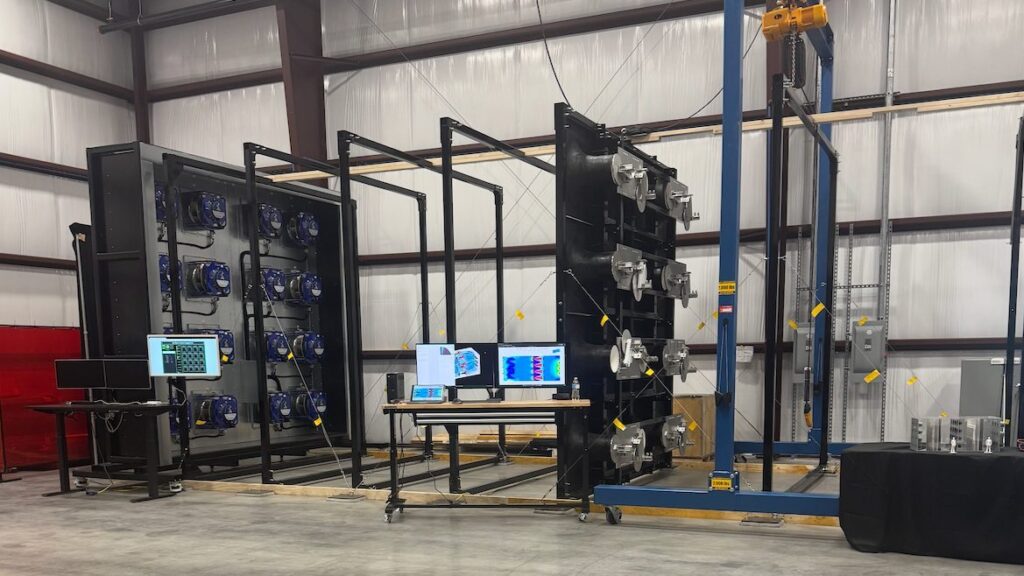
To test and validate these concepts, Q-PAC built a full-scale airflow tunnel, unveiled during the event. Designed with computational fluid dynamics (CFD) modeling and verified against AMCA 270 testing methodologies, the tunnel allows precise airflow measurement up to 70,000 CFM.

The CFD simulations modeled everything from turbulence and swirl patterns to uniformity downstream of the fan discharge. Engineers used multiple flow control screens and pressure taps to achieve a flat velocity profile across a 12×12-foot test section, meeting uniformity targets within the tolerances established by AMCA 270 for airflow tunnels.

The tunnel’s structure itself reflects Q-PAC’s engineering discipline. With more than 25,000 pounds of pressure acting across the test walls, the modular steel frame was designed to maintain structural integrity to within a tenth of an inch deflection. Each test nozzle is individually actuated, allowing automated control of airflow through 16 nozzles and enabling a range of testing conditions, from partial load to full 70,000 CFM operation.

This kind of real-time, automated testing capability provides the feedback loop manufacturers need to validate not only performance but also predictive control algorithms. With sensors embedded in the Q-PAC Fan Controller, including accelerometers that detect vibration anomalies, Q-PAC’s engineers are exploring ways to identify imbalance or installation issues automatically during commissioning.

Resiliency Through Simplicity

The heart of the conversation wasn’t just about innovation, it was about practical resilience. Facility leaders from universities and county operations shared how the system’s serviceability directly offsets the industry’s tightening labor market.

When experienced technicians retire, many organizations are left with smaller teams carrying more responsibility. The MPF’s plug-and-play design mitigates that risk. No belts to tension, no bearings to grease, no downtime waiting for specialized parts.

It’s a design principle that meets operators where they are, helping them maintain uptime with fewer skilled hands in the field.

“When you lose one motor, you don’t lose your air handler. You don’t even lose comfort,” one facilities director shared.

Industry Implications and Standards Evolution

The event also addressed a broader industry challenge: how to keep standards and testing methods aligned with accelerating innovation.

AMCA International Inc.‘s Shruti Kohli-Bhargava, IOM discussed the gap between the pace of product development and the multi-year process required to update or enhance standards such as AMCA 270 and AMCA 211.

That tension between speed and structure underscores the need for more collaboration between manufacturers, standards bodies, and testing labs. Q-PAC’s in-house airflow tunnel could help close that gap, serving as both a development tool and a testing platform for new air-moving technologies that may not yet fit neatly into existing categories.

Looking Forward

The multimotor plenum fan isn’t just a new product, it’s a new category. By merging multiple motorized impellers into one cohesive fan assembly, Q-PAC is simplifying what was once a highly customized and often misunderstood system design.

The result is a fan architecture that’s resilient by design, intuitive to maintain, and engineered for real-world operating conditions.

Attending the FLOW event highlighted an important truth: the next wave of HVAC innovation will come not just from smarter components, but from smarter systems, integrated, adaptable, and validated by data.

For engineers, facility leaders, and manufacturers alike, it’s a reminder that reliability isn’t built through redundancy, it’s built through design.

Originally published in Ashlei Rolloff’s HVAC Leaders newsletter on LinkedIn.

Quick answers

What is a multimotor plenum fan?

Q-PAC’s multimotor plenum fan (MPF) is a commercial HVAC fan design introduced at the company’s FLOW event. It rethinks the fan array to improve reliability, serviceability, and airflow control with fewer independent components to install and maintain.

What does resiliency mean in fan design?

Redundancy spreads airflow across many independent fans so one failure is covered. Resiliency aims for that same protection with less complexity, fewer parts, and fewer control points.

Why do fan arrays create maintenance challenges?

Each fan in a traditional array carries its own motor, impeller, frame, wiring, and variable frequency drive. More components mean more installation steps, longer commissioning, and more failure points over the life of the system.

Keep reading: content marketing for HVAC manufacturers and the HVAC Leaders podcast.

Work with Nerd Herd

Win more bids with marketers who speak spec sheet

Book a 30-minute strategy call and we will show you where your marketing is losing bids and what to fix first.

Book a strategy call

Filed Under: Insights

  • Page 1
  • Page 2
  • Go to Next Page »

Footer

  • About
  • Proven Process
  • AI Education
  • Work With Us
  • Our Work
  • Insights
  • Podcast
  • Careers
  • Contact
  • Privacy Policy
EOS Logo
Connect
Subscribe to Newsletter
Subscribe
© 2026 Nerd Herd