For decades, air movement in commercial HVAC systems has balanced on the edge of complexity. Fan arrays promised flexibility and redundancy, but they often introduced challenges in installation, commissioning, and long-term maintenance. As systems grew more sophisticated, so did the failure points.
At Q-PAC‘s recent FLOW event, that paradigm was redefined. The company’s introduction of the multimotor plenum fan (MPF) represents a shift in how engineers think about reliability, serviceability, and airflow control, replacing the idea of redundancy with a more precise concept: resiliency.
From Redundancy to Resiliency
Traditional fan arrays distribute airflow across multiple independent fans, each with its own motor, impeller, frame, wiring, and variable frequency drive (VFD). While this offers protection against a single fan failure, it also creates more complexity, more parts, more controls, and more opportunities for misalignment or error.
The multimotor plenum fan changes that equation. Rather than a collection of independent fans, it’s engineered as a single, cohesive air-moving system, multiple motorized impellers designed to work together under one control architecture, a single power connection, and a structural frame.
Q-PAC engineers describe it as a plenum fan built for the realities of modern operation. If one motor fails, the remaining motors increase load to maintain performance. It’s not “more than you need” as redundancy implies, it’s exactly enough.
From an end-user perspective, that distinction matters. Facility teams at the event emphasized that resiliency allows continued operation without the downtime or complexity of replacing a traditional fan wheel, belt, or bearing. In one example shared, technicians replaced four failed motors in 30 minutes, with basic hand tools. For healthcare facilities and schools where air movement directly impacts uptime and compliance, that’s a critical advancement.
Designing for Real-World Reliability
The MPF’s design philosophy begins with simplicity in service. By consolidating the electrical and control interfaces into a single input, the system reduces installation errors and speeds commissioning. The modular motor approach eliminates belts, pillow blocks, and greased bearings, components that historically drive most maintenance calls.
Panelists at the FLOW roundtable echoed the growing workforce challenge: the shortage of skilled HVAC technicians and controls specialists. In that context, Q-PAC’s engineers aimed to create a fan system that could be serviced by general maintenance personnel, not just veteran tradesmen.
“Our benchmark for serviceability is under two minutes per motor replacement,” one Q-PAC engineer noted.
In practice, one user reported completing a full motor swap in less than a minute. This approach reframes product design not around engineering novelty, but around operational reality, where reliability is measured in minutes of downtime avoided.
Engineering Validation: The Airflow Tunnel Experience
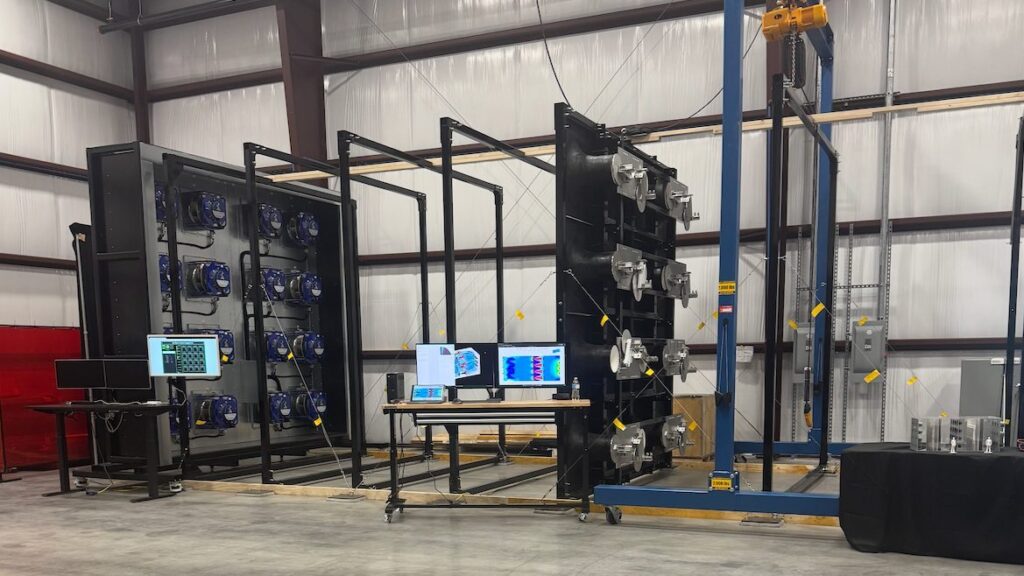
To test and validate these concepts, Q-PAC built a full-scale airflow tunnel, unveiled during the event. Designed with computational fluid dynamics (CFD) modeling and verified against AMCA 270 testing methodologies, the tunnel allows precise airflow measurement up to 70,000 CFM.
The CFD simulations modeled everything from turbulence and swirl patterns to uniformity downstream of the fan discharge. Engineers used multiple flow control screens and pressure taps to achieve a flat velocity profile across a 12×12-foot test section, meeting uniformity targets within the tolerances established by AMCA 270 for airflow tunnels.
The tunnel’s structure itself reflects Q-PAC’s engineering discipline. With more than 25,000 pounds of pressure acting across the test walls, the modular steel frame was designed to maintain structural integrity to within a tenth of an inch deflection. Each test nozzle is individually actuated, allowing automated control of airflow through 16 nozzles and enabling a range of testing conditions, from partial load to full 70,000 CFM operation.
This kind of real-time, automated testing capability provides the feedback loop manufacturers need to validate not only performance but also predictive control algorithms. With sensors embedded in the Q-PAC Fan Controller, including accelerometers that detect vibration anomalies, Q-PAC’s engineers are exploring ways to identify imbalance or installation issues automatically during commissioning.
Resiliency Through Simplicity
The heart of the conversation wasn’t just about innovation, it was about practical resilience. Facility leaders from universities and county operations shared how the system’s serviceability directly offsets the industry’s tightening labor market.
When experienced technicians retire, many organizations are left with smaller teams carrying more responsibility. The MPF’s plug-and-play design mitigates that risk. No belts to tension, no bearings to grease, no downtime waiting for specialized parts.
It’s a design principle that meets operators where they are, helping them maintain uptime with fewer skilled hands in the field.
“When you lose one motor, you don’t lose your air handler. You don’t even lose comfort,” one facilities director shared.
Industry Implications and Standards Evolution
The event also addressed a broader industry challenge: how to keep standards and testing methods aligned with accelerating innovation.
AMCA International Inc.‘s Shruti Kohli-Bhargava, IOM discussed the gap between the pace of product development and the multi-year process required to update or enhance standards such as AMCA 270 and AMCA 211.
That tension between speed and structure underscores the need for more collaboration between manufacturers, standards bodies, and testing labs. Q-PAC’s in-house airflow tunnel could help close that gap, serving as both a development tool and a testing platform for new air-moving technologies that may not yet fit neatly into existing categories.
Looking Forward
The multimotor plenum fan isn’t just a new product, it’s a new category. By merging multiple motorized impellers into one cohesive fan assembly, Q-PAC is simplifying what was once a highly customized and often misunderstood system design.
The result is a fan architecture that’s resilient by design, intuitive to maintain, and engineered for real-world operating conditions.
Attending the FLOW event highlighted an important truth: the next wave of HVAC innovation will come not just from smarter components, but from smarter systems, integrated, adaptable, and validated by data.
For engineers, facility leaders, and manufacturers alike, it’s a reminder that reliability isn’t built through redundancy, it’s built through design.
Originally published in Ashlei Rolloff’s HVAC Leaders newsletter on LinkedIn.
Quick answers
What is a multimotor plenum fan?
Q-PAC’s multimotor plenum fan (MPF) is a commercial HVAC fan design introduced at the company’s FLOW event. It rethinks the fan array to improve reliability, serviceability, and airflow control with fewer independent components to install and maintain.
What does resiliency mean in fan design?
Redundancy spreads airflow across many independent fans so one failure is covered. Resiliency aims for that same protection with less complexity, fewer parts, and fewer control points.
Why do fan arrays create maintenance challenges?
Each fan in a traditional array carries its own motor, impeller, frame, wiring, and variable frequency drive. More components mean more installation steps, longer commissioning, and more failure points over the life of the system.
Work with Nerd Herd
Win more bids with marketers who speak spec sheet
Book a 30-minute strategy call and we will show you where your marketing is losing bids and what to fix first.